
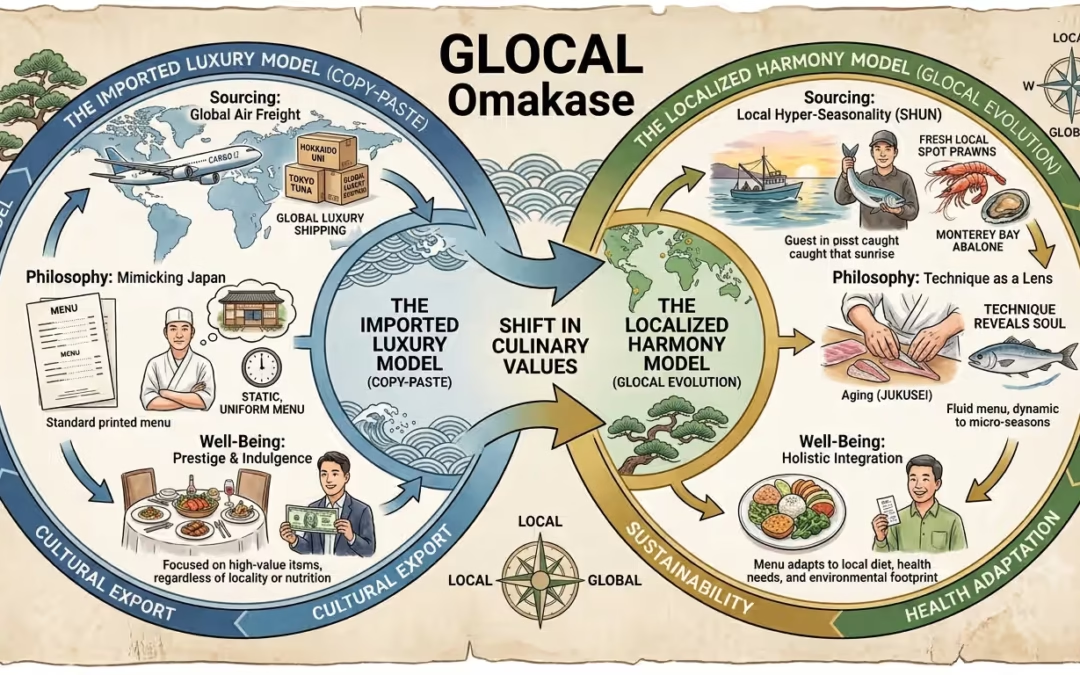
The New Frontier: “Glocal Omakase” Mastery
The global sushi boom has turned omakase into a predictable luxury ritual. To justify multi-hundred-dollar price tags, high-end restaurants worldwide lean on the same carbon-heavy blueprint: fly in Hokkaido uni, Miyazaki wagyu, and Tokyo bluefin, print a 15-course script, and replicate Japan as closely as possible.
That copy-paste model misreads what omakase actually is. It was never a list of imported luxury items. It’s a philosophy — and the chefs applying centuries-old Japanese technique to local, seasonal ingredients, tuned to the people actually sitting at the counter, are producing better meals than the import model ever could.
1. Shun Doesn’t Survive a Flight
The bedrock of omakase is *shun* (旬) — an ingredient at its sharpest, most vital peak. Traditional Japan tracked this obsessively: the old lunisolar calendar, imported from China in the 6th century and localized by court astronomer Shibukawa Shunkai in 1685, divides the year into 72 *kō*, or micro-seasons, each lasting about five days. That’s the level of precision the concept demands.
Local sourcing solves this directly:
-
The living catch: An Omakase chef in California working with Monterey Bay spot prawns pulled that morning, or a chef in Spain using wild Mediterranean sea bass from local waters, is serving something an air-freighted ingredient structurally cannot match: immediacy.
-
Respecting natural rhythms: Sourcing locally forces a kitchen to stay synced to its own geography. If a regional mackerel is only at its best for a six-week window in late summer, that window becomes the point — a hyper-seasonal moment no import can replicate, because it doesn’t exist anywhere else.
2. Bioregional Balance: Tuning the Menu to the Guest, Not the Archipelago
*Washoku*, the traditional Japanese cuisine, evolved around the needs of an island nation — iodine-rich sea minerals, specific ferments, lean proteins suited to Japan’s climate and daily life. Transplanting that exact nutritional blueprint onto diners in a different climate, with different baseline diets and metabolisms, isn’t fidelity to the tradition. It’s a misread of *omotenashi* — the hospitality principle the whole cuisine is built on, which is about reading the guest in front of you, not imposing a template.
A chef who adapts to local health context is doing the more faithful thing:
- Calibrating the shari: Sushi rice depends on a precise balance of vinegar, salt, and sugar. A chef paying attention will shift that balance — acidity, sweetness, serving temperature — to suit the climate and the diners eating in front of them.
- Ecosystem-driven seasoning: Native micro-greens, wild regional herbs, and local plant-forward garnishes replace imported ones that were chosen for a different place and a different diet.
- Traceability as trust: Local, transparent fisheries let a chef vouch for water quality directly, rather than trusting a supply chain three time zones away.
3. Technique Beats Prestige
There’s an old line among *itamae*: anyone with money can buy expensive fish. It takes an artisan to reveal what’s actually in it.
The real discipline of Japanese gastronomy was never geographic — it’s technique, and it transfers cleanly to any body of water:
- Jukusei (aging): Dry- or wet-aging local white fish for days breaks proteins down through the ATP-to-inosinate chain, building the umami compounds (IMP) that fresh fish alone doesn’t have time to develop. This is measurable food chemistry, not folklore.
- Kombujime and shime: Curing fish between sheets of kombu (kombujime) or with salt and vinegar (shime — the same family of technique behind shimesaba) draws out moisture and layers in glutamate-driven umami from the kelp. Both techniques date to the Edo period and were developed specifically as preservation methods, not luxury flourishes.
- Thermal precision: Serving fish calibrated to near body temperature lets its natural fat render on contact — a technique detail, not a sourcing one.
The Actual History Backs This Up
Omakase purists who insist on Japanese-only ingredients are arguing against the tradition’s own origin story. Edomae sushi — the direct ancestor of the modern omakase counter — was invented as a workaround, not a luxury format. In early 19th-century Edo (Tokyo), fish caught in Tokyo Bay had to be preserved without refrigeration, so chefs developed vinegar curing, salt curing, and kelp curing to make the catch last.
Around 1824, a chef named Hanaya Yohei took it further: instead of the days-long fermentation that sushi had traditionally required, he served fresh fish on vinegared rice immediately, sold from waterfront carts to dockworkers as fast food. That’s the actual founding gesture of the cuisine — fast, local, adapted to what was in the bay that day, built for the people eating it. It was a technique-driven response to a specific place, not an aesthetic imported from somewhere else.
The chefs building omakase around local bio-regions today aren’t deviating from that lineage. They’re the ones still practicing it. A fixed 15-course menu flown in from Tokyo is the copy. A menu built on absolute freshness, executed with real technique, and tuned to the person sitting at the counter — that’s the original idea, still working.
Putting Glocal Omakase Into Practice
This isn’t a theoretical position. It’s the operating principle behind the Omakase consultancy and dining experiences I build with chefs and restaurants: source from the water and soil you actually have, apply the discipline without the copy-paste, and design the meal around the guest sitting in front of you — their climate, their diet, their day.
The results speak for themselves. A menu built on same-day local catch and calibrated seasoning consistently outperforms the imported-luxury script, on both flavor and how the guest feels afterward — and it does it with a fraction of the carbon footprint and a fraction of the cost of flying fish across the world.
If you’re a chef, restaurateur, or hospitality group rethinking what Omakase means outside Japan, this is worth a real conversation. Reach out at krishnamagar.com — the craft is stronger when more kitchens commit to it.